![Town of Stonington Maine [logo]](/_img/ele/lgo-205x149.png)
 Jane's Walk Stonington 2025
Why We Walk the Walk: Jane’s Walk and Community Engagement
From the Town of Stonington Blog
May 16th, 2026
Posted by: Linda Nelson, Economic & Community Development Director
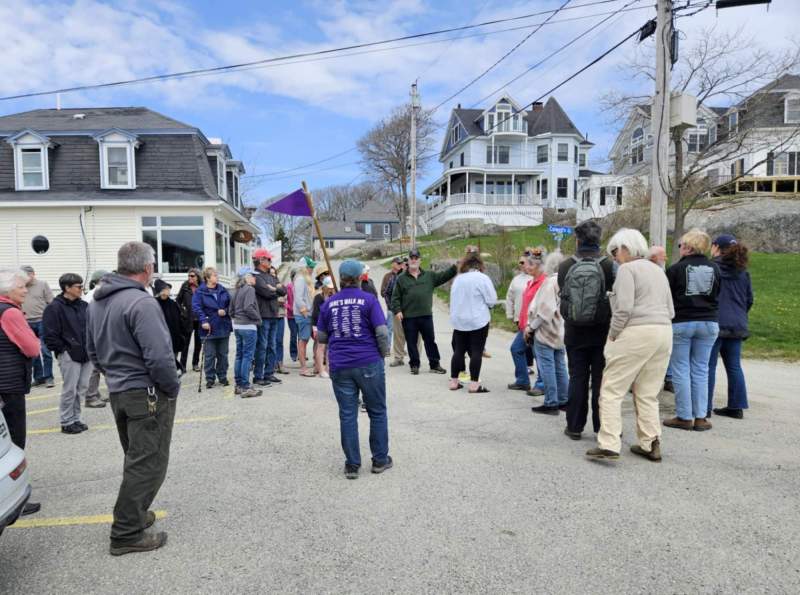
This past Saturday, May 2, we hosted the Town’s fifth annual Jane’s Walk in downtown Stonington to good attendance despite the chilly wet weather, with the walkers a balance of generational islanders and visitors who specifically traveled to Stonington for the Walk.
Why do we walk the walk?
To inspire community engagement in planning and decision making about our shared future.
This annual, first weekend of May international series of walking conversations celebrate the legacy of grassroots community development activist and author Jane Jacobs as a demonstration that individuals can shape the future of the communities in which we want to live.
Walkers learned of several upcoming opportunities to engage: two public visioning sessions for updating Stonington’s 2018 Comprehensive Plan, the first of which was in person May 5 and the second, an all-virtual meeting, on May 19; volunteering for a comp plan working group on a particular topic by emailing econdev@stoningtonmaine.org; AND completing our community survey at surveymonkey.com/r/stonington1.
On Saturday, we walked through island history, current actions and future needs starting with the Declaration of Independence in 1776.
The first white colonists to Deer Isle, the Greenlaws, the Eatons, the Billings arrived in 1761 and 1762 from Massachusetts (already crowded!) seeking land to farm–merely 14 years before the Declaration and ensuing revolution.
The surnames alone are a beacon of the island’s resilience, and the story of that resilience is consistent creativity and adaptation to change.
Farming was possible on Little Deer Isle and in north Deer Isle but not so very much on the rest of this granite rock surrounded by ocean.
The colonists, following in the footsteps of the indigenous people who seasonally migrated to Deer Isle, took to the seas as mariners, fishermen, and lobster and shellfish harvesters. There was in particular a long-standing Penobscot family resident on the island who were descendants of Daylight Mitchell – a Frenchified name for a family whose original name was Lobster and was said to have always lived near the lobsters. Local historian and retired anthropologist Bill Haviland argues that, based on the continued presence of these descendants well into the 20th century, the original name for the island was “place of the lobsters.”
Ultimately, the colonists and others realized that the rock itself on which they were sitting was valuable.
Within 100 years of the first settlers the southern half of the island, originally known as Green’s Landing, became part of a granite quarrying boom that transformed the humble landing into Stonington and brought thousands of immigrants to live in densely packed rooming houses and cut and quarry stone.
This legacy continues today, with Stonington as the dense commercial working waterfront for the island and French-Canadian quarry workers arriving seasonally from Quebec to work in the last remaining active quarry.
During the same late-19th century period, Deer Isle mariners became renowned for crewing two America’s Cup-winning sailboats, the Defender (1895) and the Columbia (1899).
How do we extend these heroic legacies into the future?
This year’s Jane’s Walkers learned of some of the Town’s recent activities in securing planning and implementation grants to adapt to the harbor’s rising and warming tides and the economic changes these foretell. Investing in our working waterfront infrastructure is part of a community vision to remain Maine’s most productive fishing harbor year round, and to not succumb solely to the siren calls of seasonal tourism and destination housing.
Jane Jacobs’ book, The Death and Life of Great American Cities, put a pin into the death grip of mid-century, large scale planners more focused on the needs of vehicles than of people. Her later policy victories over Robert Moses, a planner known as “the power broker” in New York City, to stop the construction of an expressway through lower Manhattan neighborhoods demonstrated the power of individuals to influence the places we live and the participatory planning approaches that are proven to support local residents in connecting, supporting each other, improving a sense of shared identity and strengthening and/or creating liveable communities.
We invite you to join us and to participate in planning opportunities for Stonington, and the island’s, future. Attend a meeting. Volunteer. And all are welcome to take our community survey at surveymonkey.com/r/stonington1. Responses will be sorted and analyzed by each participant’s relationship to Stonington.
More information, meeting schedules, and links are at www.stoningtonmaine.org.
Comments for this Post
(comments = 0)
Leave a comment